Civil War & Reconstruction
Robert Smalls
American politician and former slave (1839-1915)
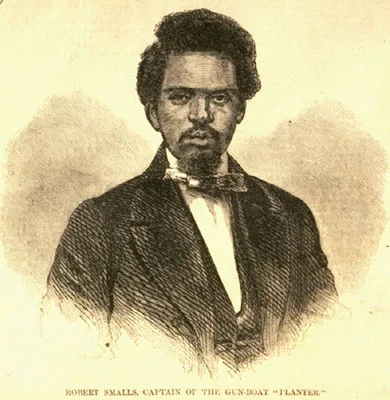
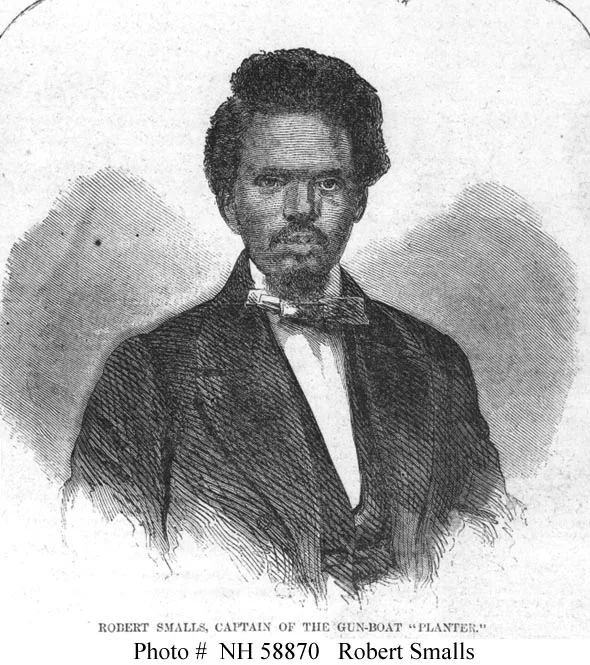
Overview
Robert Smalls, born into slavery in 1839 in Beaufort, South Carolina, carried out one of the most audacious acts of self-liberation of the entire Civil War: while still enslaved and working aboard a Confederate transport ship in Charleston Harbor, Smalls commandeered the vessel and, disguised as its captain, sailed it directly past Confederate defenses to reach the Union naval blockade — freeing himself, his crew, and their families in a single, meticulously planned act, and delivering a Confederate warship to the Union in the process.
Working the Harbor He Would Later Escape Through
At his mother’s request, Smalls was hired out to Charleston at 16 to work as a laborer, earning $16 a week of which he was allowed to keep only $1, the rest paid to his enslaver; he worked as a hotel worker, a lamplighter, and eventually a dockworker and wheelman — effectively serving as a helmsman, though enslaved men were legally barred from holding that title — building an intimate knowledge of Charleston Harbor that would prove decisive years later. Smalls married Hannah Jones, an enslaved hotel maid, in 1856, and the couple tried to save $800 to purchase their family’s freedom outright; by 1861 they had saved only $100, a shortfall that made Smalls’s 1862 harbor escape not just an act of political defiance but the only realistic path to freedom his family had left.
Turning a Daring Escape Into National Influence
Smalls’s escape was not only personally consequential but politically significant on a national scale: his example and his direct advocacy helped persuade President Abraham Lincoln to accept Black soldiers into the Union Army, a policy shift that eventually brought roughly 180,000 Black soldiers into Union ranks, as documented on this site’s own Civil War & Emancipation page. Smalls’s childhood under enslavement had itself been shaped by his mother Lydia Polite’s deliberate insistence that he witness field labor and whippings despite being favored by their enslaver, specifically so he would understand the plight of enslaved field workers rather than be shielded from it.
Legacy
After the war, Smalls returned to Beaufort and built a substantial political career during Reconstruction, winning election to the South Carolina Legislature and then the United States House of Representatives, where he authored the state legislation that gave South Carolina the first free, compulsory public school system in the United States. A founder of the South Carolina Republican Party, Smalls remained the last member of that party to represent South Carolina’s 5th congressional district for well over a century, a striking measure of how thoroughly Reconstruction-era Black political power was subsequently dismantled by Jim Crow — and of how singular Smalls’s own achievement had been.