Harlem Renaissance
Langston Hughes
American writer and social activist (1901–1967)
Overview
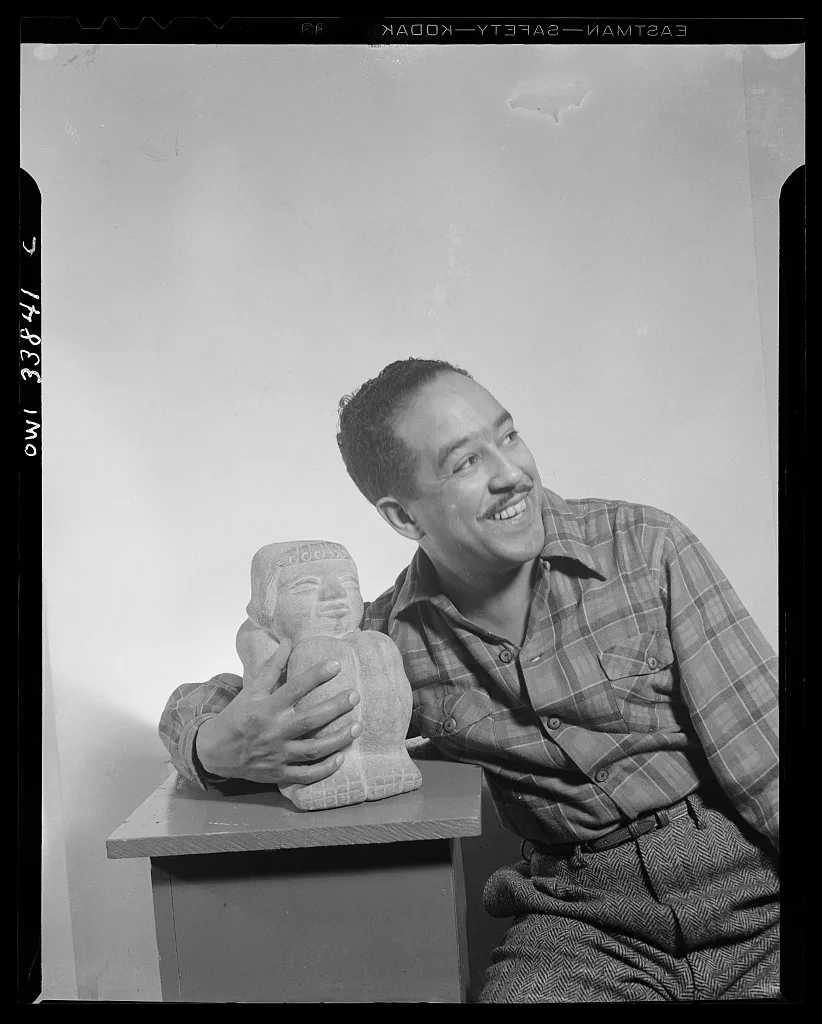
Langston Hughes, born in Joplin, Missouri, in 1901, became one of the defining literary voices of the Harlem Renaissance and an early pioneer of jazz poetry, a form that brought the rhythms and improvisational spirit of jazz music directly into written verse. Hughes wrote prolifically from a young age, and after moving to New York City and briefly studying at Columbia University, he gained early notice in The Crisis magazine before his first poetry collection, The Weary Blues, was published in 1926, establishing him as a central voice in Harlem’s creative community even before he completed his degree at Lincoln University.
A Family Rooted in Resistance
Hughes’s family history connected him directly to earlier chapters of Black resistance this site documents elsewhere: his maternal grandmother, Mary Patterson, one of the first women to attend Oberlin College, married Lewis Sheridan Leary, who in 1859 joined John Brown’s armed raid on Harpers Ferry and was killed there. Ten years after Leary’s death, his widow Mary married into the politically active Langston family; her new husband Charles Henry Langston and his brother John Mercer Langston had helped lead the Ohio Anti-Slavery Society. Charles and Mary’s daughter Carrie became a schoolteacher and, with husband James Nathaniel Hughes, had a son: Langston Hughes, born in 1901, and raised largely by that same grandmother, Mary, whose stories of Black resistance and dignity directly shaped the sense of racial duty that defined his life’s work.
“Elected” Class Poet by Stereotype
Hughes later recalled his childhood as marked by loneliness after his grandmother Mary’s death, writing in his 1940 memoir The Big Sea, “I was unhappy for a long time, and very lonesome, living with my grandmother. Then it was that books began to happen to me.” His writing career began almost by accident: elected class poet in grammar school in Lincoln, Illinois, Hughes later reflected wryly that he was “a victim of a stereotype” — with only two Black students in the class and a teacher who constantly stressed poetry’s rhythm, “everyone knows, except us, that all Negroes have rhythm, so they elected me as class poet.” He went on to write for his high school newspaper and edit its yearbook in Cleveland, Ohio, under the encouragement of teacher Helen Maria Chesnutt.
Legacy
Beyond poetry, Hughes wrote plays, novels, short story collections, and nonfiction, and from 1942 to 1962 — spanning the buildup to the modern Civil Rights Movement — he wrote a widely read weekly opinion column for the Chicago Defender, one of the nation’s leading Black newspapers, giving him a sustained public platform through the movement’s critical early decades. Hughes’s body of work, combining literary innovation with direct, accessible engagement with Black political life, makes him one of the most enduring bridges between the cultural achievement of the Harlem Renaissance and the political organizing of the civil rights era that followed it.
Related
More in Literature