Contemporary
National Underground Railroad Freedom Center
museum in Cincinnati, Ohio, United States
This page describes a preserved 19th-century slave pen used to hold enslaved people before sale.
Overview
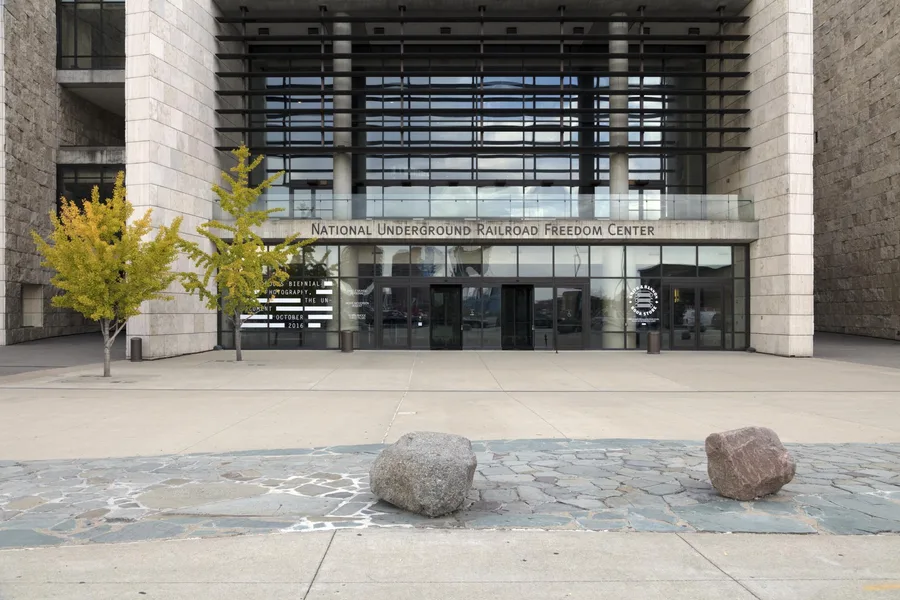
The National Underground Railroad Freedom Center opened in downtown Cincinnati, Ohio, on August 3, 2004, after ten years of planning, fundraising, and construction, built specifically to honor the Underground Railroad and, more broadly, all historical and ongoing efforts to abolish human enslavement and secure freedom for all people. Its location was deliberately chosen: Cincinnati sits directly across the Ohio River from the former slave states of the South, and the city played a documented, central role in the Underground Railroad as thousands of freedom seekers crossed the river to reach it, with many finding temporary refuge in the city before continuing north toward Canada.
A Museum of Conscience
The Freedom Center is recognized as one of a distinct category of “museums of conscience” in the United States, grouped alongside institutions including the United States Holocaust Memorial Museum and the National Civil Rights Museum — museums built not merely to display historical artifacts but to actively challenge visitors to examine the meaning of freedom and justice in their own lives today. The $110 million, 158,000-square-foot building, designed by Boora Architects with Blackburn Architects, is organized around three pavilions themed to courage, cooperation, and perseverance — according to architect Walter Blackburn, the building’s undulating form was designed specifically to evoke the fields and rivers that freedom seekers crossed on their way to liberty.
A Real Slave Pen, Preserved Intact
The museum’s most powerful artifact is not a recreation: a genuine two-story log slave pen, built around 1830 by Revolutionary War veteran and slave trader Captain John Anderson, was moved intact from a Kentucky farm — where a tobacco barn had been built around it, hiding it for generations — and reconstructed inside the museum’s atrium. By 2003 it was identified as the only known surviving rural slave jail in the country; men were chained on its second floor through iron rings still visible today, while women were held on the ground floor near the fireplace they used for cooking, as traders like Anderson waited for favorable prices before shipping captives onward to markets in Natchez and New Orleans. “The pen is powerful,” museum curator Carl Westmoreland has said. “It has the feeling of hallowed ground. When people stand inside, they speak in whispers.”
Legacy
The Freedom Center’s opening drew high-profile support, with First Lady Laura Bush, Oprah Winfrey, and Muhammad Ali all attending its groundbreaking ceremony — a signal of the broad cultural significance placed on preserving and teaching this history. By locating a major national museum of freedom directly on the historical crossing point thousands of enslaved people once used to reach liberty, and by preserving an actual slave pen rather than only its likeness, the Freedom Center transforms a specific geographic site of historical significance into an active, ongoing site of public education about both the Underground Railroad and the broader, continuing pursuit of human freedom this site documents across every era.
Related
- Mae Jemison
- The Legacy Museum and National Memorial for Peace and Justice
- National Civil Rights Museum at the Lorraine Motel
- Negro Leagues Baseball Museum
- National Museum of African American History and Culture
- Texas Southern University
More in Civil Rights, Education