Contemporary
Mae Jemison
American doctor and NASA astronaut
Overview
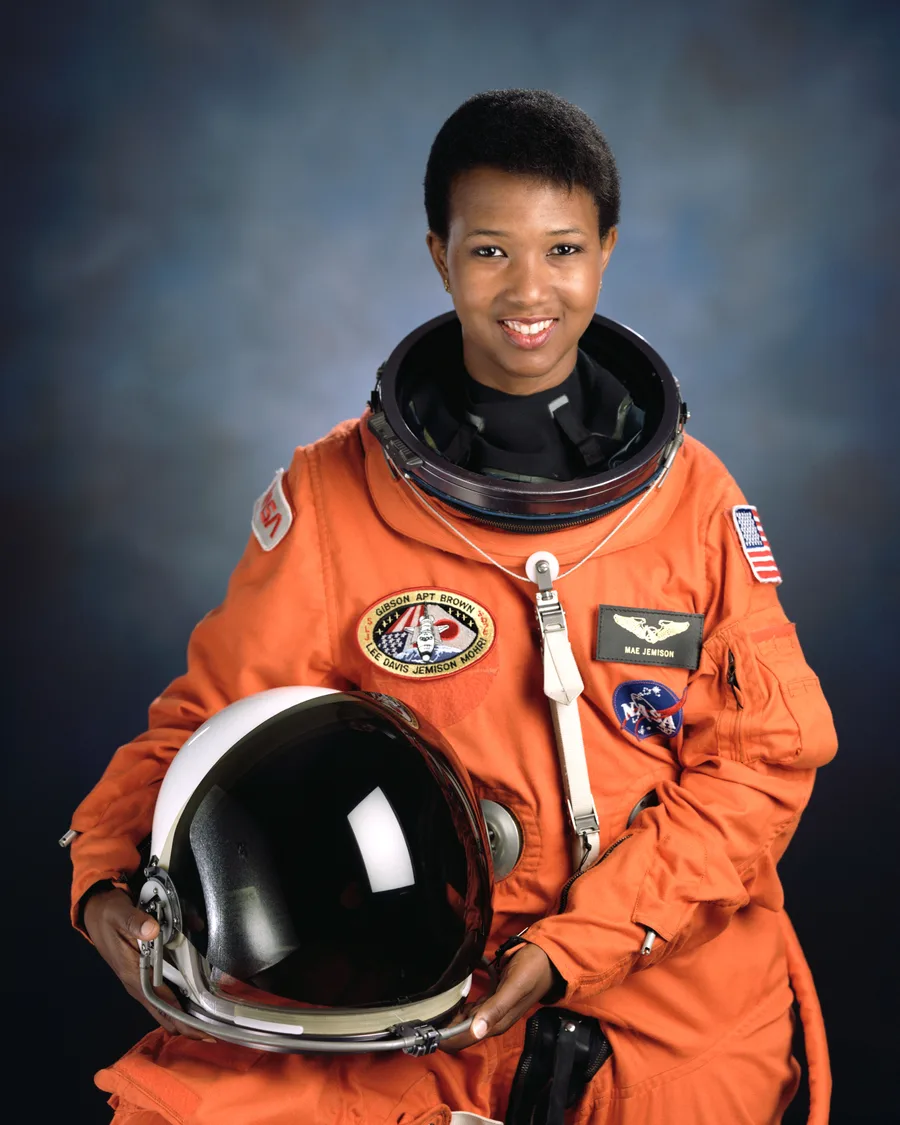
Mae Carol Jemison, born in Decatur, Alabama, in 1956 and raised in Chicago, became the first African American woman to travel into space when she served as a mission specialist aboard the Space Shuttle Endeavour’s STS-47 mission in September 1992, an eight-day orbital mission that made her a historic first in American spaceflight. Jemison’s path to NASA ran through an unusually broad course of study: she graduated from Stanford University with degrees in both chemical engineering and African and African-American studies before earning her medical degree from Cornell University.
“There Were No Women Astronauts”
Jemison’s ambitions faced skepticism early: when she told a kindergarten teacher she wanted to be a scientist, the teacher assumed she meant a nurse, and watching the Apollo missions as a child, Jemison recalled being “really really irritated that there were no women astronauts.” She was equally serious about dance, training from age eight or nine in ballet, jazz, modern, African, and Japanese dance styles, and at 16 she entered Stanford University, where — one of very few Black students in her classes — she led the Black Students Union and choreographed a full dance production, later crediting a degree of youthful arrogance as something she believed women and minorities in a white, male-dominated society sometimes need to succeed.
From the Peace Corps to NASA
Before joining NASA’s astronaut corps in 1987, Jemison served as a Peace Corps medical officer in Liberia and Sierra Leone from 1983 to 1985, working as a general practitioner in West Africa — direct, hands-on medical service that preceded her selection for astronaut training. This combination of engineering rigor, medical practice, dance training, and international humanitarian service gave Jemison a distinctive professional foundation that set her apart even among NASA’s competitive astronaut corps.
Legacy
After leaving NASA in 1993, Jemison founded a technology research company and later established a nonprofit educational foundation, through which she now leads the DARPA-funded 100 Year Starship project; she has also written children’s books and made a notable 1993 guest appearance on Star Trek: The Next Generation, a fitting connection for the first Black woman to actually reach space. Jemison holds multiple honorary doctorates and has been inducted into both the National Women’s Hall of Fame and the International Space Hall of Fame, recognition of a career that has continued expanding scientific and educational opportunity well beyond her historic 1992 spaceflight.
Related
- The Legacy Museum and National Memorial for Peace and Justice
- National Civil Rights Museum at the Lorraine Motel
- Negro Leagues Baseball Museum
- National Museum of African American History and Culture
- Texas Southern University
- National Underground Railroad Freedom Center
More in Arts, Literature, Science, Education