Colonial America
African Burial Ground National Monument
national monument in New York City
This page discusses a colonial-era cemetery for enslaved and free Africans in New York City.
Overview
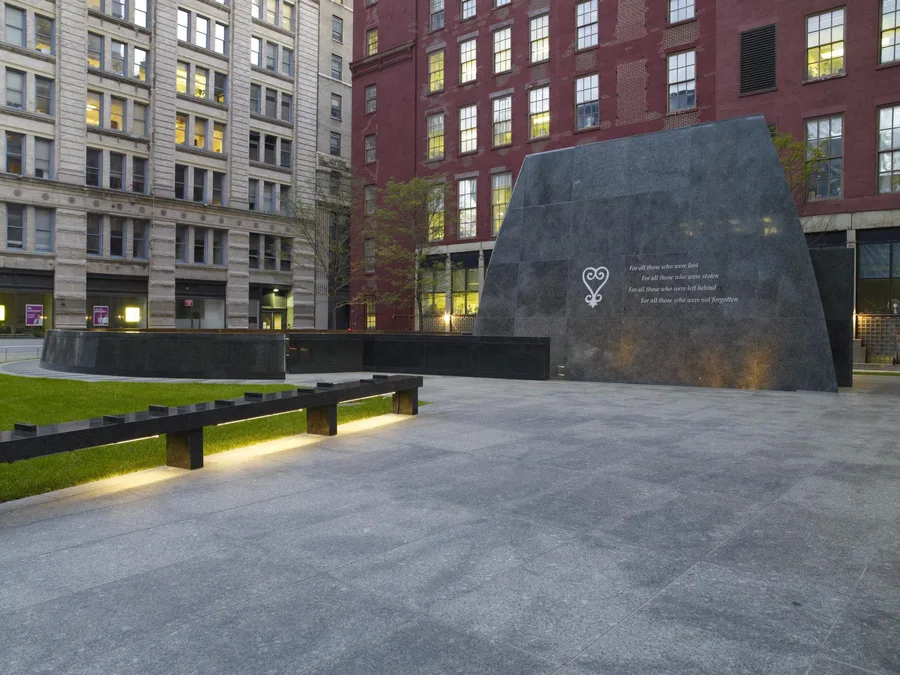
The African Burial Ground National Monument, in Lower Manhattan, preserves a portion of what was once the largest colonial-era cemetery for people of African descent in North America — a site containing the remains of more than 419 documented individuals, though historians estimate the full cemetery, active during the 17th and 18th centuries, may have held as many as 10,000 to 20,000 burials of enslaved and free Black New Yorkers. Its rediscovery during 1990s federal construction work was called “the most important historic urban archaeological project in the United States,” and it revealed a history that had been almost entirely erased from the city’s popular memory.
Slavery’s Beginning in New York, in 1626
Slavery in the New York area began around 1626 under the Dutch West India Company with the arrival of eleven enslaved men — their recorded names, including Paul D’Angola and Simon Congo, preserving the African regions of origin the company itself documented — followed two years later by enslaved Angolan women; the city’s first slave auction was held in 1655 at Pearl and Wall Streets. Dutch colonial slavery was, in narrow ways, less absolute than what followed: in 1643, Paul D’Angola and his companions successfully petitioned the Dutch West India Company for their freedom and won land to farm, and by the mid-17th century free Black farms covered 130 acres where Washington Square Park now stands. That changed when England seized the colony in 1664 and renamed it New York, imposing harsher slave codes than Dutch rule had allowed.
New York’s Forgotten Enslaved Population
The burial ground’s discovery forced a reckoning with a fact routinely omitted from popular narratives of American slavery as a purely Southern institution: by the American Revolutionary War, enslaved Africans made up nearly a quarter of colonial New York City’s population, and New York held the second-largest enslaved population of any American city, behind only Charleston, South Carolina. Scholars and African American civic activists organized together to publicize the site’s significance and successfully lobbied for its preservation rather than allowing construction to proceed over it, a grassroots preservation campaign that directly produced the site’s federal protection.
Legacy
The site was designated a National Historic Landmark in 1993 and a full national monument by President George W. Bush in 2006, and following a 2003 congressional appropriation and a design competition that drew more than 60 proposals, a memorial was dedicated at the site in 2007 to commemorate the role of enslaved and free Africans in building colonial and federal New York City. The African Burial Ground stands today as physical, undeniable evidence that Northern cities were built substantially on enslaved Black labor too — a fact this site’s sourcing standards require stating plainly rather than letting slavery’s history be told as a purely Southern story.
Related
More in Civil Rights