Reconstruction
Frederick Douglass National Historic Site
preserves the Washington, D.C. home and estate of Frederick Douglass
Overview
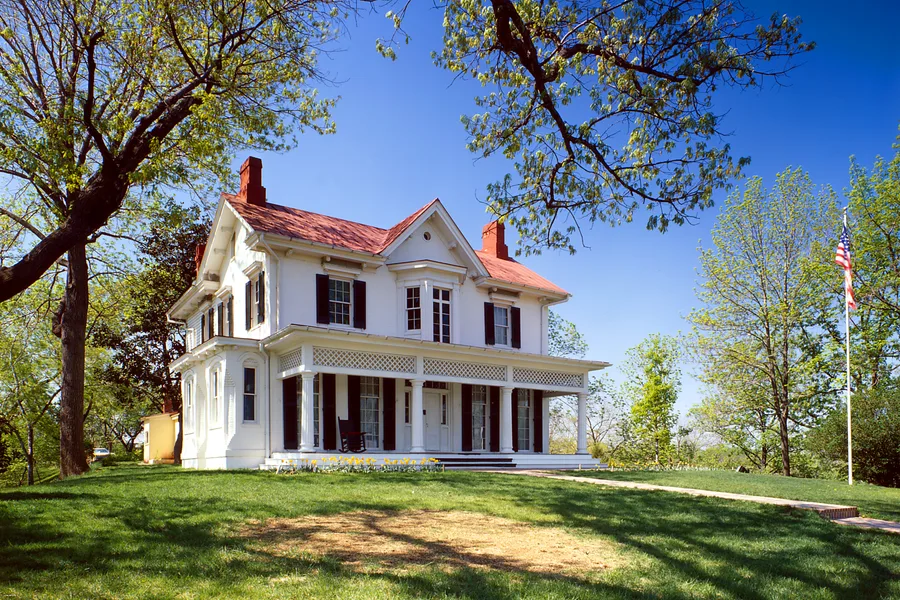
The Frederick Douglass National Historic Site preserves Cedar Hill, the Anacostia, Washington, D.C., home where Frederick Douglass — one of the most influential African Americans of the 19th century — lived from 1877 until his death in 1895. Perched on a hilltop with a sweeping view of the U.S. Capitol, the house was originally built by John Van Hook around 1855; Douglass purchased it in 1877 and expanded it from 14 rooms to 21, adding a two-story library wing that reflected his identity as one of the era’s most prolific writers and orators.
A Historic Federal Appointment
Douglass’s years at Cedar Hill coincided with a landmark moment in his public career: following Rutherford B. Hayes’s 1876 election, Douglass was appointed U.S. Marshal for the District of Columbia — the first time a Black man received a federal appointment requiring U.S. Senate confirmation. Though Douglass was pointedly excluded from some of the position’s traditional ceremonial duties, such as formally introducing guests to the President at White House functions, the appointment itself stood as a genuine, historic breakthrough in Black political representation at the federal level.
A Second Marriage That Scandalized Washington
In January 1884, three years after his first wife Anna’s death left him, in his words, with “the main pillar of my house” fallen, Douglass married Helen Pitts, a white Mount Holyoke graduate he had employed as a clerk and who had previously taught freed Black Americans in Virginia and Indiana. The marriage drew open hostility from both families and the press — one newspaper wrote of Douglass, “his picture hangs in our parlor, we will hang it in the stables” — but Pitts herself said simply, “Love came to me and I was not afraid to marry the man I loved because of his color.” Douglass died at Cedar Hill on February 20, 1895, collapsing shortly after returning from a women’s rights rally where he had been escorted to the platform by Susan B. Anthony.
Legacy
After Douglass’s death, Helen Pitts Douglass founded the Frederick Douglass Memorial and Historical Association in 1900 specifically to preserve Cedar Hill, and in 1916 the National Association of Colored Women’s Clubs joined that preservation effort — meaning Cedar Hill survived its first crucial decades as a landmark through organized Black women’s activism, not federal protection, which came only decades later when the site was formally established as a National Historic Site in 1988. The home was chosen in 2017 to represent Washington, D.C., on the U.S. Mint’s America the Beautiful quarter program, and Cedar Hill remains preserved largely as Douglass left it, standing today as a direct, physical link to the home life of a man who spent his final decades as one of the most prominent Black public intellectuals and political figures in the country.
Related
- Blanche K. Bruce
- Frederick Douglass
- Hiram Rhodes Revels
- Alabama A&M University
- Alabama State University
- Alcorn State University
More in Literature, Civil Rights