Reconstruction
Fisk University
historically black university in Nashville, Tennessee, US
Overview
Fisk University is a private, historically Black liberal arts college in Nashville, Tennessee, founded in 1866 as the Fisk Free Colored School during Reconstruction, shortly after the Civil War’s end. Its 40-acre campus is a historic district listed on the National Register of Historic Places, and in 1930 Fisk became the first historically Black institution accredited by the Southern Association of Colleges and Schools — it is the oldest institution of higher education in Nashville.
Founding by the American Missionary Association
The school was founded by John Ogden, Erastus Milo Cravath, and Edward Parmelee Smith of the American Missionary Association to educate freedmen in Nashville, one of several schools the Association helped establish across the South for that purpose. It was named for Clinton B. Fisk, a Union general and assistant commissioner of the Freedmen’s Bureau of Tennessee, who secured a former military barracks near Union Station to house the school along with $30,000 in government funds for its endowment. Enrollment reached 900 within its first several months, with students ranging in age from seven to seventy. In 1867 the school reorganized and incorporated as Fisk University, and in 1875 James Dallas Burrus, John Houston Burrus, and Virginia E. Walker became the first African-American students to graduate from a liberal arts college south of the Mason-Dixon line.
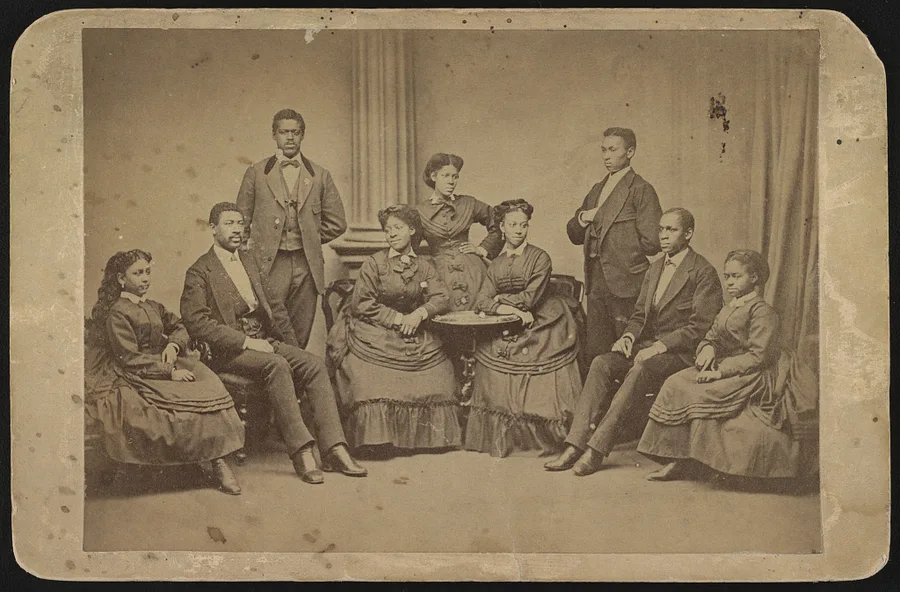
The Fisk Jubilee Singers
Facing financial distress, the university’s student choir, the Fisk Jubilee Singers, toured to raise funds beginning in 1871 under professor and treasurer George L. White. They performed before Ulysses S. Grant, Mark Twain, and Queen Victoria, popularized spirituals such as “Swing Low, Sweet Chariot,” and helped change racial stereotypes in the process. The tour raised nearly $50,000 (roughly $1.16 million in 2024 dollars), funding construction of Jubilee Hall — the first building built for the education of freedmen in the South, and now a National Historic Landmark.