c. 1804 CE – 1903 CE
Sokoto Caliphate
independent Islamic Caliphate, in West Africa from 1804 to 1903
Date range and summary are drafted from Wikidata pending a scholarly-source verification pass — treat as approximate, not settled fact, until re-sourced from academic historians/archaeologists.

Overview
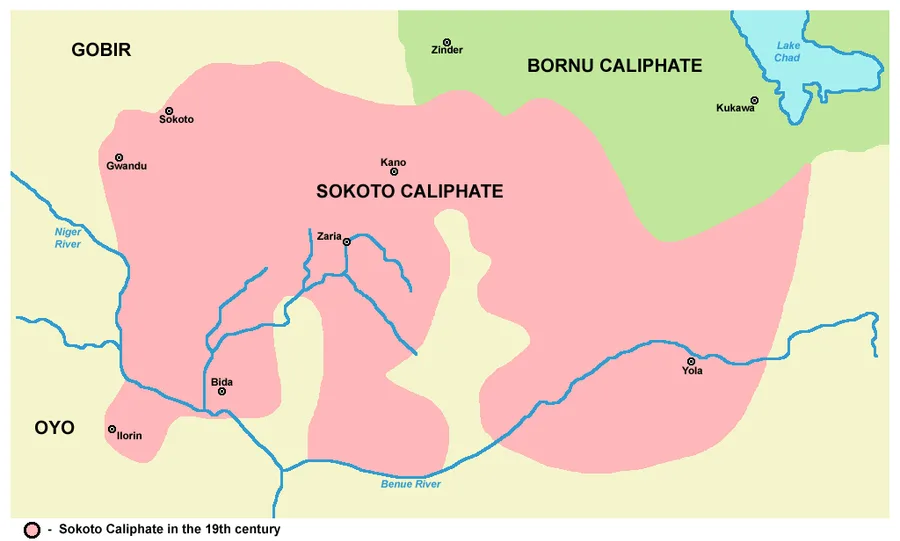
The Sokoto Caliphate was a major Sunni Muslim state in West Africa, founded in 1804 by the scholar and reformer Usman dan Fodio after he led the Fulani jihad that defeated the Hausa Kingdoms in the Fulani War. At its height under its sixth caliph, Ahmadu Rufai, the caliphate covered a vast swath of West Africa across parts of what are now Nigeria, Niger, Cameroon, and Burkina Faso, and by 1837 it governed a population estimated at 10 to 20 million people — making it, at the time, the most populous state in all of West Africa and, according to historian John Iliffe, “the most prosperous region in tropical Africa.”
A Center of Islamic Scholarship
Sokoto’s founding leaders were themselves major scholars: Usman dan Fodio, his brother Abdullahi, and his son Muhammad Bello together wrote more than three hundred books between them, covering subjects from Islamic law and Quranic interpretation to mathematics, astronomy, medicine, and governance — works still studied across West Africa and beyond today. Among the caliphate’s most celebrated scholars was Nana Asma’u, Usman dan Fodio’s own daughter, a poet, teacher, and prolific writer in Arabic, Fula, and Hausa who organized a female education network across the caliphate, training women teachers who then carried literacy and religious instruction into rural communities — a documented, women-led education system that stands among the caliphate’s most significant and often underrecognized achievements.
Governance and a Documented Legacy of Slavery
The caliphate operated as a loose confederation of more than thirty emirates, each recognizing the religious and political authority of the Sultan of Sokoto while retaining considerable local autonomy — one of the largest and most administratively complex independent polities anywhere in Africa at the time. This site’s sourcing standards require stating plainly that Sokoto’s economy relied heavily on enslaved labor: by 1900, historians estimate the caliphate held between one and possibly as many as two and a half million enslaved people, making it, by some scholarly estimates, the second-largest slave-based society in the modern world after the American South. Usman dan Fodio’s jihad also inspired a wave of related reform movements across the wider Sahel, leading to the founding of Islamic states in territory that is now Senegal, Mali, Chad, and Sudan, before the caliphate itself fell to British conquest in 1903 with the death of its last ruler, Caliph Attahiru.