c. 1100 CE – 1900 CE
Kanem-Bornu Empire
former country in Africa
Date range and summary are drafted from Wikidata pending a scholarly-source verification pass — treat as approximate, not settled fact, until re-sourced from academic historians/archaeologists.
Overview
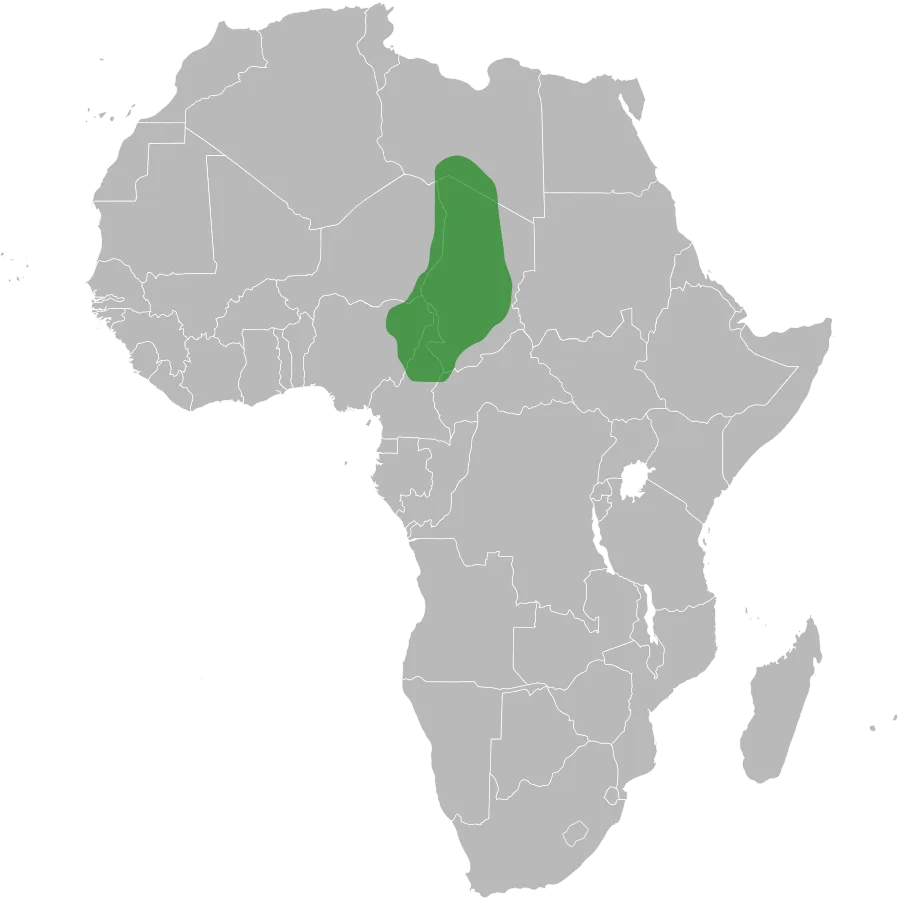
The Kanem–Bornu Empire, centered on Lake Chad, ranks among the oldest and longest-lived empires in African and world history, with roots believed to reach back to around 700 CE and a political line that, in one form or another, persisted for well over a thousand years — governing territory across what is now Nigeria, Niger, Cameroon, Chad, and parts of Libya, Algeria, and Sudan. The empire’s remarkable durability rested on its control of trans-Saharan trade routes, moving salt, ivory, and other goods between West Africa and the Mediterranean world for centuries, with its salt industry alone prosperous enough to supply the surrounding region.
Islam, Trade, and a Golden Age
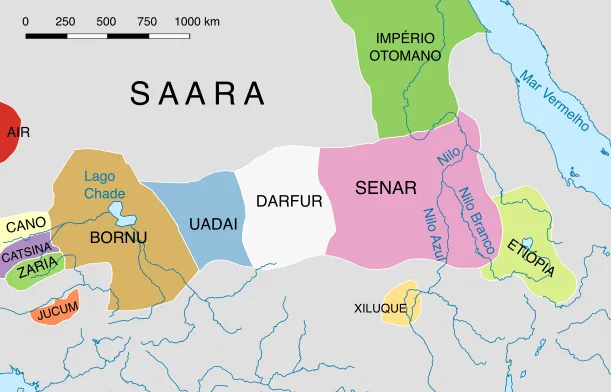
Kanem converted to Islam in the 11th century, a transition that brought a change of ruling dynasty from the Duguwa to the Sayfawa line, and the empire reached its first zenith in the 13th century under Mai Dunama II Dibalemi, who extended Kanem’s control over Saharan trade routes at their peak. After losing its original heartland of Kanem to conflict with the Bilala people in the 14th century, the empire relocated and rebuilt around the Bornu region, eventually founding a durable new capital at Ngazargamu — a resilience that let the state survive a major territorial loss and re-center itself as “Bornu” rather than collapse.
Mai Idris Alooma and the Empire’s Peak
The Bornu-centered empire reached the height of its power and influence in the late 16th century under Mai Idris IV Alooma, one of the most capable rulers in the empire’s long history, whose reign is remembered for administrative reform and military modernization. Kanem-Bornu remained a significant regional power for generations afterward, even as its influence gradually declined through the 17th century amid shifting trade patterns and environmental pressures. The empire nearly collapsed during the Fula jihads of the early 19th century, which shifted the region’s center of power west to the newly formed Sokoto Caliphate, and saw the ancient Sayfawa dynasty finally replaced by the al-Kanemi line.
Legacy
Kanem-Bornu’s final chapter came in 1893, when the Sudanese warlord Rabih az-Zubayr conquered the empire and imposed a brutal military regime, weakening it enough for France to exploit the resulting unrest during the colonial partition of the region shortly after. Across its more than a millennium of continuous political existence — one of the longest unbroken state traditions anywhere in African history — Kanem-Bornu built and sustained a trans-Saharan trading economy, an early and enduring Islamic scholarly tradition in the central Sudan, and administrative institutions whose influence on the political culture of the Lake Chad region persisted well into the colonial and modern eras.