c. 1350 CE – 1549 CE
Jolof Empire
former country
Date range and summary are drafted from Wikidata pending a scholarly-source verification pass — treat as approximate, not settled fact, until re-sourced from academic historians/archaeologists.
Overview
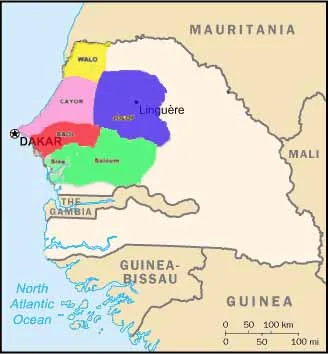
The Jolof Empire, also known as Great Jolof or the Wolof Empire, was a major state built by the Wolof people in what is now Senegal, extending its authority into parts of modern Mauritania and Gambia from roughly the mid-14th century until 1549. For much of its early history Jolof existed as a vassal of the powerful Mali Empire, remaining within Mali’s political and economic sphere of influence until the latter half of the 14th century, when it emerged as an independent power in its own right — a transition that mirrors how several West African states rose from beneath larger empires as those empires’ own control loosened.
Founding Traditions
Wolof oral tradition credits the empire’s founding to Ndiadiane Ndiaye, a figure whose origin story survives in several different versions — some accounts give him an Almoravid Islamic lineage tracing to Mecca, others describe him as being of Fulani origin, and still others identify him as a Serer prince — but all versions agree that he arrived as an outsider of noble bearing who was chosen to resolve a dispute among the region’s existing Lamane chiefs and was subsequently established as ruler, unifying Wolof, Serer, and Fula communities north of the Senegal River under a single political structure.
A Legend of a Fairly Divided Dispute
One widely told version of Ndiadiane Ndiaye’s legend holds that after fleeing a troubled family situation he lived an aquatic life along the Senegal River until reaching Waalo, where feuding local Lamane chiefs were on the verge of bloodshed over a land dispute; a mysterious stranger emerged from a lake, divided the disputed territory fairly, and vanished, so astonishing the people that when he reappeared they made him their ruler. According to this tradition, the ruler of the neighboring Kingdom of Sine, himself reputed to be a great magician, was so struck by the account that he urged all rulers between the Senegal and Gambia rivers to voluntarily submit to this new leader — which they did, founding the empire. Historian John Donnelly Fage instead dates Jolof’s rise to the 14th-century decline of the older Takrur state, while other scholars connect its independence to a Mali Empire succession dispute around 1360 — competing scholarly accounts this site notes openly rather than resolving with false certainty.
Legacy
Jolof’s political structure directly shaped the states that followed it: after the Battle of Danki in the mid-16th century, several of its vassal kingdoms — including Kayor, Baol, and Waalo — became fully or effectively independent, and it is these successor Wolof kingdoms, more than the original empire itself, that dominated Senegambian history through the era of Atlantic trade and into the colonial period. Jolof’s legacy survives today in Wolof cultural and political identity across Senegal and the wider region, and in the enduring memory of Ndiadiane Ndiaye as the founding figure of organized Wolof statehood.
Related
- Aksum Empire
- Kingdom of Benin
- Kingdom of Buganda
- Kingdom of Burundi
- Kingdom of Dahomey
- Ethiopian Empire (Solomonic Dynasty)
More in Politics