1800–1863
The Underground Railroad Era
network of secret routes & safehouses in 19th-century U.S. used by slaves to find freedom
Overview
The Underground Railroad was an organized network of secret routes and safe houses that helped enslaved people self-emancipate to the free Northern United States and Canada, formally organizing among Northern abolitionist societies beginning in the 1780s and operating until the Emancipation Proclamation in 1863 made the network’s core purpose obsolete. Freedom seekers had escaped enslavement without organized help since the earliest days of American slavery, but the Underground Railroad transformed individual acts of self-liberation into a coordinated, sustained system — one built and run primarily by free and formerly enslaved Black Americans themselves, assisted by white and Black abolitionist allies.
A Name Born of Frustration and Metaphor
The network’s evocative name has several documented possible origins: one account traces it to a young enslaved man’s hope for a railroad that “went underground all the way to Boston,” while chronicler Robert Clemens Smedley wrote that frustrated slave catchers, losing fugitives’ trails as far north as Pennsylvania, concluded in bewilderment that “there must be an underground railroad somewhere.” Journalist Scott Shane traced the earliest documented use of the phrase to an 1842 abolitionist newspaper article by Thomas Smallwood. Operators built an entire coded vocabulary around the railway metaphor: the Big Dipper, whose bowl points toward the North Star, was called the “drinking gourd,” and the network itself was known as the “freedom train” or “Gospel train,” bound for “Heaven” — meaning Canada.
Passengers and Conductors
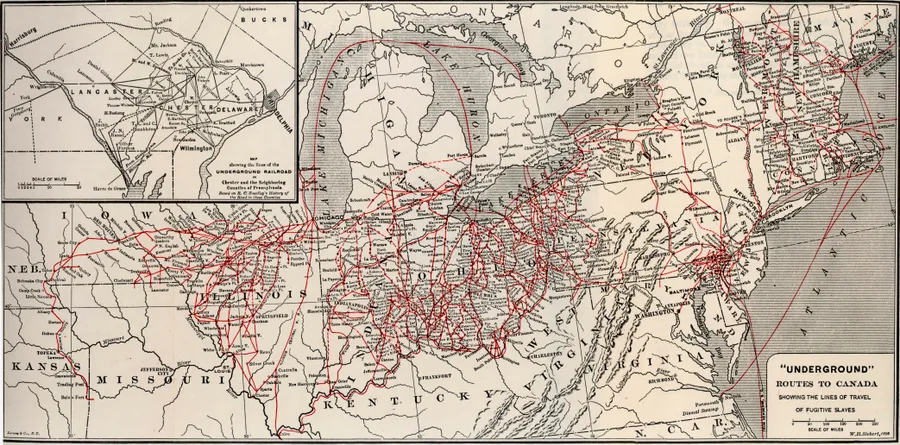
The network followed rivers, coastlines, roads, and other natural and constructed travel routes, with those who escaped and those who guided them known respectively as “passengers” and “conductors” of the Railroad — terminology that framed self-emancipation as a deliberate, organized journey rather than a desperate, isolated act. Routes led not only north to free states and Canada but also south toward Spanish Florida in the late 17th and 18th centuries, and west toward Mexico, where slavery had been abolished, demonstrating that freedom seekers pursued every viable path available to them across the full geography of the Americas. An estimated 30,000 to 40,000 freedom seekers ultimately settled in Canada, roughly half of them arriving between 1850 and 1860 alone, in the years after the Fugitive Slave Act made the Northern United States a far less secure final destination.
Scale and Legacy
The Underground Railroad’s true scale is difficult to state with precision, since its operators worked in deliberate secrecy to survive, but scholarly estimates suggest roughly 100,000 enslaved people had reached freedom via the network by 1850, and historian J. Blaine Hudson, former dean of the College of Arts and Sciences at the University of Louisville, estimated that 500,000 or more African Americans had self-emancipated by the network’s methods by the end of the Civil War. During the war itself, the same routes and networks helped enslaved people escape to Union lines to claim their freedom directly. The Underground Railroad stands as one of history’s most successful mass acts of coordinated self-liberation, organized and largely led by the very people seeking their own freedom rather than delivered to them by outside intervention.
Related entries
More in Civil Rights