Bantu Migration Era
name for a postulated millennia-long series of migrations of speakers of the original proto-Bantu language group
Overview
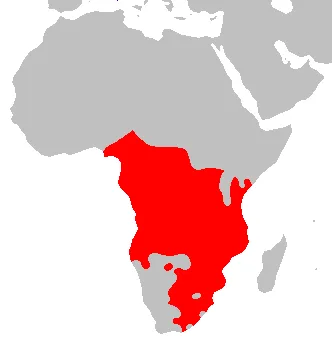
The Bantu expansion was one of the most consequential population movements in human history: over thousands of years, Proto-Bantu-speaking communities originating in the borderlands between Cameroon and Nigeria spread across Central, Eastern, and Southern Africa, eventually giving rise to the several hundred related Bantu languages spoken by hundreds of millions of Africans today. The expansion is documented through converging lines of evidence — linguistic analysis showing the close relationship among Bantu languages across sub-equatorial Africa, genetic evidence of large-scale population movement out of Central Africa, and archaeology — rather than resting on any single source, giving it an unusually solid evidentiary foundation for such an ancient process.
Two Streams Across a Continent
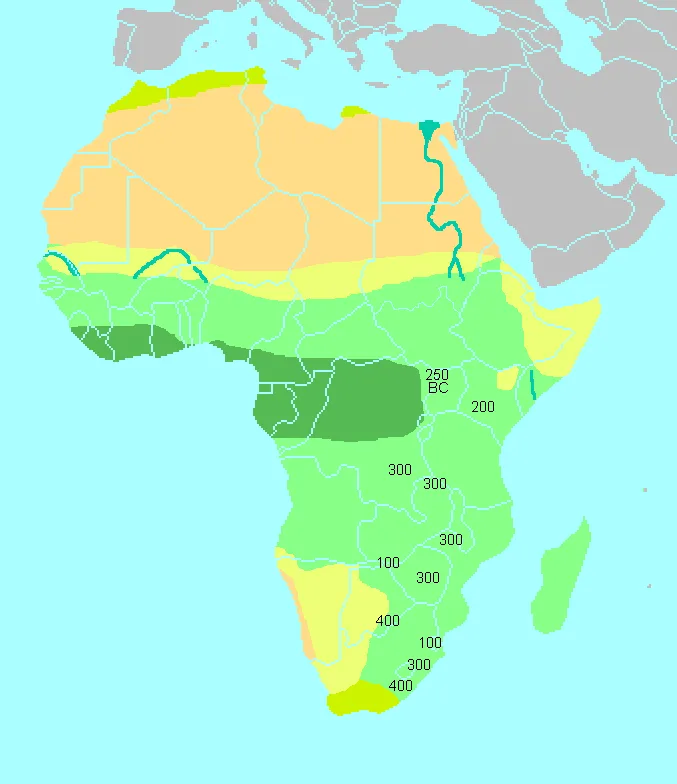
The expansion is generally dated to between roughly 4,000 BCE and 500 CE and is understood to have proceeded along two broad routes: a “Western Stream” moving south along the Atlantic coast and through the Congo rainforest, reaching central Angola by around 500 BCE, and an “Eastern Stream” moving along the northern edge of the forest and the Ubangi River toward the Great Lakes region, also arriving west of Lake Victoria by around 500 BCE, before splitting further to spread across Eastern and Southern Africa. Bantu-speaking communities are believed to have reached as far south as present-day South Africa by around 300 CE, a millennium-spanning migration that repeatedly brought incoming Bantu-speaking farmers and ironworkers into contact — and sometimes conflict, sometimes assimilation — with existing hunter-gatherer and pastoralist populations across the continent.
Tracing the Migration Through DNA
A 2023 genetic study analyzing 1,487 Bantu speakers across 143 populations in 14 African countries found that the expansion began roughly 4,000 years ago in West Africa and involved substantial interbreeding between incoming Bantu speakers and the local populations they encountered, rather than simple wholesale replacement — genetic evidence that complements and refines the earlier linguistic and archaeological picture. Dental and archaeological evidence further suggests the common ancestors of West African and Proto-Bantu peoples may have originated in the western Sahara during the Kiffian period, migrating south into West Africa as the Green Sahara dried into desert around 7000 BCE, before Proto-Bantu farmers in Nigeria and Cameroon eventually diverged into distinct Eastern and Western Bantu-speaking branches between roughly 2500 and 1200 BCE.
Legacy
The Bantu expansion is the demographic and linguistic foundation underlying most of the societies profiled elsewhere on this site: Buganda, Rwanda, Burundi, Kongo, and the wider Bantu-speaking world of Central, Eastern, and Southern Africa all trace their linguistic ancestry to this migration, making it arguably the single most important population movement in African history for understanding how the continent’s modern linguistic and ethnic map took shape. Because the expansion unfolded over thousands of years and is reconstructed primarily through linguistics, genetics, and archaeology rather than written or continuous oral record, significant scholarly debate continues over its exact routes, timing, and causes — debate this site’s sourcing standards require presenting honestly rather than resolving with false certainty.