1812–1861
The Antebellum Era
Historical period in the American South
This page discusses the enslavement of African Americans in the pre-Civil War South.
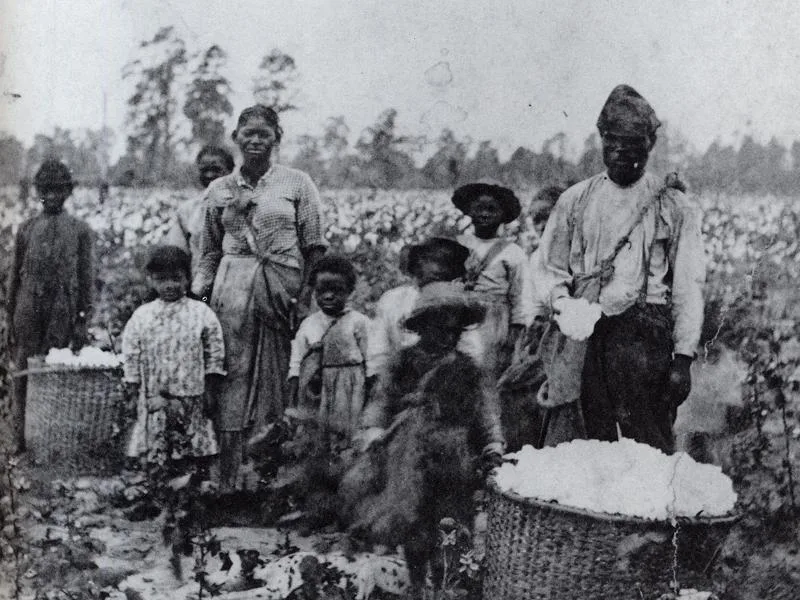

Overview
The Antebellum era spans the period between the end of the War of 1812 and the start of the Civil War in 1861, a stretch of decades in which chattel slavery became the defining economic and social institution of the American South. Roughly 700,000 enslaved people lived in the United States in 1790 — about one in six people in the country — and rather than fading out, as some early observers expected, slavery’s economic grip on the South tightened dramatically after Eli Whitney’s cotton gin made short-staple cotton newly profitable in the 1790s, transforming what some southern leaders had once treated as an awkward, temporary institution into one they actively defended and expanded.
A Plantation Economy, Not an Industrial One
The Antebellum South’s economy was deliberately built around a single export commodity rather than domestic manufacturing: cotton demand from Northern textile mills drove massive agricultural expansion, but a prevailing anti-industrial, agrarian ideology among Southern elites meant the region developed little industry of its own, remaining chronically short of liquid capital and dependent on imported manufactured goods from the North and England. The plantation system itself functioned essentially as an agricultural factory, concentrating enslaved labor under centralized management to produce a single cash crop at scale — an economic model built specifically around the expansion of slavery rather than around any diversified regional economy.
A Divided, Unequal Society
Southern antebellum society was highly stratified: wealth concentrated sharply among large slaveholding landowners, whose profits from enslaved labor entrenched their political dominance, while the region’s manufacturing base lagged behind the North’s, and European immigrants largely avoided a society they correctly perceived as offering little opportunity outside the slaveholding elite. As the country expanded westward, the question of whether new territories would permit slavery became the central, unresolvable political conflict of the era, setting the stage directly for the Civil War.
Correcting the Historical Record
In the decades after the Civil War, a deliberate historical revisionism took hold — sometimes called the Lost Cause narrative — that mischaracterized the Confederate cause as heroic, falsely portrayed enslaved people as content with their condition, and denied that slavery was the war’s central cause. This site’s sourcing standards reject that narrative outright: contemporary evidence, including the Confederate states’ own secession declarations, makes clear that the defense and expansion of slavery was the war’s primary cause, and enslaved people’s own actions before, during, and after the war — escape, rebellion, wartime service, and the rapid building of free institutions after emancipation — demonstrate agency and resistance rather than contentment. The antebellum era’s true legacy is not the mythology built around it afterward, but the documented resilience of the enslaved people who survived it and the free Black communities that grew in the North throughout the same period.
Related entries
More in Civil Rights